The enchanting world of toy museums

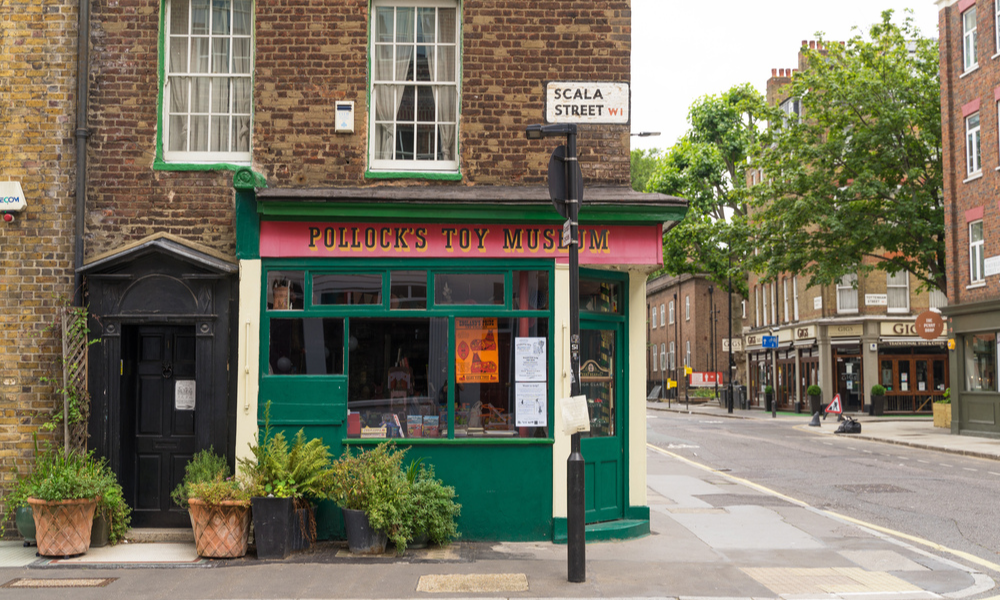
Pollock’s Toy Museum, Croydon, London

This feature was first published in October 2025 in My Mensa Weekly, our exclusive newsletter for Mensa members. Find out more about becoming a Mensa member here.

Words: Leila Johnson

Pollock’s Toy Museum is currently based in Croydon and Leadenhall Market and is known around the world for its collection of historical toys. Visitors can expect to find everything from puppets and dolls’ houses to games, folk toys and the museum’s famous toy theatre collection.

Founded in 1956, but with a much older collection – including a 4,000-year-old toy mouse – it is one of the oldest museums in the UK. Museum trustee and former curator Debby Brown explains the enduring allure of toy museums and highlights some artefacts that may appeal to Mensa members in particular…

Do toys impact audiences in a different way to other kinds of museum artefacts?

Since everyone has been a child, a museum of toys has quite an advantage in connecting with visitors. Seeing a half-forgotten but once-loved plaything can unlock a whole range of memories and emotions, which people are often keen to share with each other, their children and sometimes our staff, too.

For younger visitors it is a different experience, since they largely come without those references, sometimes puzzling or questioning a toy’s purpose, imagery or material construction. We run regular Saturday family drop-in sessions to invite curiosity and imagination with hands-on making and playing, which creates links with historical and cultural childhood themes and toys.

Are there any problem-solving toys in the collection that may be of particular interest to Mensa members?

There are traditional games from around the world with principles similar to chess or ‘Fox and Geese’; they have differing moves or unequal sides that require forward planning and strategy. We also have quite a number of horse-racing games from the 1890s to the 1930s, when family gambling games became acceptable and popular. Some are quite complicated, requiring a studied mix of calculation, prediction and memory as well as luck. Domestic stakes were usually quite modest – halfpennies, buttons or matchsticks – although we’ve been told competition could be pretty fierce, with cheating accepted or even encouraged as an addition to the excitement.

Construction toys also demonstrate problem solving, particularly those which leave it to the maker to devise interesting structures that don’t fall over. These usually come with instructions, but it’s often more fun to just try things and see what happens. We have two engineering sets, which supply the tools for making your own components either from a small amount of metal supplied with the kit or from cutting up tin cans from the recycling – the main problem to solve there being how to avoid cutting yourself!

We have puzzles too, graded in complexity to tease the brains of children from tots to teens, including a Rubik’s Cube, of course.

Are any of your games or toys designed for educational purposes?

Most games educate in subtle ways, but manufacturers realised very early on that labelling any toy as educational was a sure selling point to parents, however thin the claim. We have early 19th-century jigsaws (or ‘dissected puzzles’, as they were first known), and board and card games, which are certainly didactic. These generally teach and test religious, moral, geographical or historical knowledge.

There are also numerous games in the collection which directly involve number calculation, spelling or languages; and there are also one or two examples from educational pioneers, such as Maria Montessori and the Abbatts. We are keen to collect more of these, as well as books and games made for school use.

What are your most popular toys?

At the main museum in Croydon, TV’s Sooty and Sweep glove puppets (yes, the actual ones from The Sooty Show!) face the entrance door and enjoy instant recognition from a certain age group, together with Basil Brush, a somewhat lonely single Womble, and Paddington Bear. Toy Story’s Woody and Buzz Lightyear attract a slightly younger audience, and for the more historically curious, our 4,000-year-old Egyptian toy mouse simply astounds.

At Leadenhall’s mini museum the French clockwork doll, who emerges from a cardboard cabbage and blows kisses, is very popular with visitors and staff alike, together with a group of elderly teddy bears enjoying Edwardian games.

Of course, Pollock’s famous toy theatres are the core entertainment, and the reason the museum started 70 years ago. The craze dates back to the Regency period (early 19th century) when children would put on plays at home using paper cut-outs of figures and scenery recreating full-scale productions. We commission contemporary artists to create updated versions. Toy theatres are available to perform with and watch – twice daily on many Saturdays – with audience participation and behind-the-scenes visits encouraged.

TOY MUSEUM TOUR

Museum of Childhood, Edinburgh

This museum was the very first of its kind in the world, opening to the public in 1955. Its enchanting collection of toys and memorabilia features favourites from the 1800s to the present day, including coin-operated musical dioramas.

Dolls’ House and Toy Museum, Ty Twt, Newport, Pembrokeshire

Explore a treasured display of dolls’ houses and toys of the past inherited and collected by sisters Pam and Val Ripley. The family’s collection, put into storage during the Second World War, was rediscovered in the late 1970s.

National Museum of Ireland, Dublin

Ireland’s national repository cares for a large collection of dolls from across Ireland, England and Europe. It also has a smaller collection of other toys, including dolls’ houses, board games and clockwork toys.

Image credit:Travers Lewis / Shutterstock.com

The enchanting world of toy museums

This feature was first published in October 2025 in My Mensa Weekly, our exclusive newsletter for Mensa members. Find out more about becoming a Mensa member here.

Words: Leila Johnson

Pollock’s Toy Museum is currently based in Croydon and Leadenhall Market and is known around the world for its collection of historical toys. Visitors can expect to find everything from puppets and dolls’ houses to games, folk toys and the museum’s famous toy theatre collection.

Founded in 1956, but with a much older collection – including a 4,000-year-old toy mouse – it is one of the oldest museums in the UK. Museum trustee and former curator Debby Brown explains the enduring allure of toy museums and highlights some artefacts that may appeal to Mensa members in particular…

Do toys impact audiences in a different way to other kinds of museum artefacts?

Since everyone has been a child, a museum of toys has quite an advantage in connecting with visitors. Seeing a half-forgotten but once-loved plaything can unlock a whole range of memories and emotions, which people are often keen to share with each other, their children and sometimes our staff, too.

For younger visitors it is a different experience, since they largely come without those references, sometimes puzzling or questioning a toy’s purpose, imagery or material construction. We run regular Saturday family drop-in sessions to invite curiosity and imagination with hands-on making and playing, which creates links with historical and cultural childhood themes and toys.

Are there any problem-solving toys in the collection that may be of particular interest to Mensa members?

There are traditional games from around the world with principles similar to chess or ‘Fox and Geese’; they have differing moves or unequal sides that require forward planning and strategy. We also have quite a number of horse-racing games from the 1890s to the 1930s, when family gambling games became acceptable and popular. Some are quite complicated, requiring a studied mix of calculation, prediction and memory as well as luck. Domestic stakes were usually quite modest – halfpennies, buttons or matchsticks – although we’ve been told competition could be pretty fierce, with cheating accepted or even encouraged as an addition to the excitement.

Construction toys also demonstrate problem solving, particularly those which leave it to the maker to devise interesting structures that don’t fall over. These usually come with instructions, but it’s often more fun to just try things and see what happens. We have two engineering sets, which supply the tools for making your own components either from a small amount of metal supplied with the kit or from cutting up tin cans from the recycling – the main problem to solve there being how to avoid cutting yourself!

We have puzzles too, graded in complexity to tease the brains of children from tots to teens, including a Rubik’s Cube, of course.

Are any of your games or toys designed for educational purposes?

Most games educate in subtle ways, but manufacturers realised very early on that labelling any toy as educational was a sure selling point to parents, however thin the claim. We have early 19th-century jigsaws (or ‘dissected puzzles’, as they were first known), and board and card games, which are certainly didactic. These generally teach and test religious, moral, geographical or historical knowledge.

There are also numerous games in the collection which directly involve number calculation, spelling or languages; and there are also one or two examples from educational pioneers, such as Maria Montessori and the Abbatts. We are keen to collect more of these, as well as books and games made for school use.

What are your most popular toys?

At the main museum in Croydon, TV’s Sooty and Sweep glove puppets (yes, the actual ones from The Sooty Show!) face the entrance door and enjoy instant recognition from a certain age group, together with Basil Brush, a somewhat lonely single Womble, and Paddington Bear. Toy Story’s Woody and Buzz Lightyear attract a slightly younger audience, and for the more historically curious, our 4,000-year-old Egyptian toy mouse simply astounds.

At Leadenhall’s mini museum the French clockwork doll, who emerges from a cardboard cabbage and blows kisses, is very popular with visitors and staff alike, together with a group of elderly teddy bears enjoying Edwardian games.

Of course, Pollock’s famous toy theatres are the core entertainment, and the reason the museum started 70 years ago. The craze dates back to the Regency period (early 19th century) when children would put on plays at home using paper cut-outs of figures and scenery recreating full-scale productions. We commission contemporary artists to create updated versions. Toy theatres are available to perform with and watch – twice daily on many Saturdays – with audience participation and behind-the-scenes visits encouraged.

TOY MUSEUM TOUR

Museum of Childhood, Edinburgh

This museum was the very first of its kind in the world, opening to the public in 1955. Its enchanting collection of toys and memorabilia features favourites from the 1800s to the present day, including coin-operated musical dioramas.

Dolls’ House and Toy Museum, Ty Twt, Newport, Pembrokeshire

Explore a treasured display of dolls’ houses and toys of the past inherited and collected by sisters Pam and Val Ripley. The family’s collection, put into storage during the Second World War, was rediscovered in the late 1970s.

National Museum of Ireland, Dublin

Ireland’s national repository cares for a large collection of dolls from across Ireland, England and Europe. It also has a smaller collection of other toys, including dolls’ houses, board games and clockwork toys.

Image credit:Travers Lewis / Shutterstock.com

Related Resources

Got What it Takes

Take the Mensa IQ Test to see if you have what it takes to join the world’s highest IQ society.

Share this online